
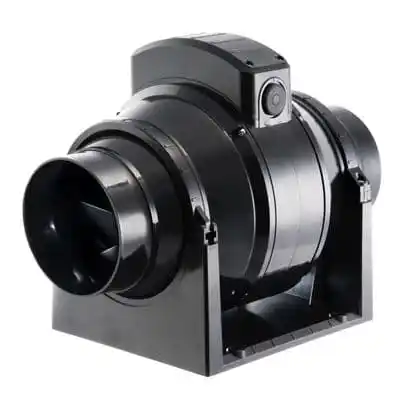
Hot kitchens, stuffy workshops, damp bathrooms and warehouses full of fumes all have the same fix: moving the right amount of air. This guide shows how ventilation fan sizing works using air changes per hour, how to pick the fan type, and the details that make a system quiet and effective.
Step 1: Find the room volume
Multiply the length, width and height of the room in metres. A workshop 10 m long, 8 m wide and 4 m high has a volume of 320 m³.
Step 2: Choose the air changes per hour
Air changes per hour (ACH) is how many times the full volume of air in the room is replaced every hour. Busy, hot or smelly spaces need more air changes than quiet ones. Guide values vary between design standards, so treat the ranges below as a starting point and confirm with a ventilation engineer for critical spaces.
| Space | Typical guide range (ACH) |
|---|---|
| Offices and meeting rooms | About 4 to 8 |
| Toilets and bathrooms | About 6 to 10 |
| Warehouses and stores | About 4 to 10 |
| Workshops and factories | About 6 to 20, higher with heat or fumes |
| Commercial kitchens | About 15 to 30 or more, with a hood |
| Plant rooms and generator rooms | Sized on heat output and equipment needs |
Step 3: Calculate the airflow
Airflow (m³/h) = room volume (m³) × air changes per hour. For the 320 m³ workshop at 10 air changes, you need about 3,200 m³/h. You can meet that with one fan or split it between two or more fans for better coverage.
Remember resistance. Fan airflow drops as ducts, bends, grilles and filters add resistance. Check the fan curve at the expected pressure, not just the free-air figure on the box.
Step 4: Pick the fan type
- Wall and window extract fans for bathrooms, small kitchens and rooms with an outside wall.
- Inline duct fans when air must travel through a duct, such as from an internal bathroom or office.
- Box fans and cabinet fans for longer ducts and commercial kitchens, often with quieter operation.
- Axial and industrial wall fans for large workshops, poultry houses and warehouses.
- Kitchen extract fans for cooking hoods, built to handle hot, greasy air.
- Roof ventilators to let hot air escape from high roofs.
Browse all of these in our ventilation range, along with louvers and diffusers.
Supply air matters as much as extract
A fan can only remove air if fresh air can get in. If a room is sealed, an extract fan will struggle, doors will whistle, and in kitchens, gas burners can be affected. Provide fresh air through louvers, door grilles or a supply fan. In kitchens, the hood captures smoke and grease at the source, and the extract fan should be matched to the hood size.
Installation tips
- Keep ducts short and straight; every bend reduces airflow.
- Place the extract on the opposite side of the room from the fresh air inlet so air sweeps across the space.
- Fit a back-draught shutter on wall fans to stop rain, dust and wind coming back in.
- Use flexible connectors to stop vibration travelling along ducts.
- Clean kitchen extract systems regularly to reduce fire risk from grease.
Frequently asked questions
How do I calculate the fan size for a room?
What is a good air change rate for a kitchen?
Should I use an inline fan or a wall fan?
Why is my extract fan noisy?
Where can I buy ventilation fans in Nairobi?
Need help sizing fans? Send us the room size and use on WhatsApp 0726 086 895 and we will suggest suitable fan types and sizes from our range.