
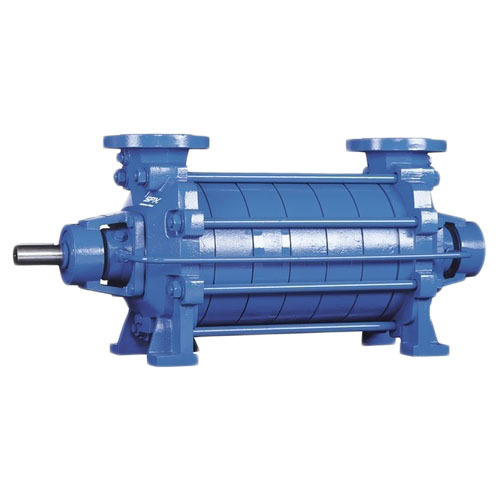
A pump that is too small will never deliver enough water. A pump that is too large wastes power, wears out faster and can damage pipes. Getting pump sizing right comes down to two numbers: how much water you need (flow) and how hard the pump must push it (head). This guide walks through both, in plain terms, for boreholes, booster sets and transfer pumps.
Step 1: Work out the flow you need
Flow is usually given in cubic metres per hour (m³/h) or litres per minute. Start from the daily demand of the building or farm, then decide how many hours a day the pump will run to meet it. For a pump filling a storage tank, the flow is the daily volume divided by the running hours.
For a booster set that feeds taps directly, size the flow on the peak demand, the moment when many taps, showers and machines are open at the same time. A plumbing engineer will normally calculate this from the number and type of fixtures.
Tip: For a borehole, never select a pump with a flow above the tested yield of the borehole. Pumping faster than the borehole can recharge will draw the water level down to the pump and can run it dry.
Step 2: Work out the total head
Head is the height, in metres, that the pump must lift water, plus the extra push needed to overcome friction and deliver pressure at the outlet. Add these parts together:
- Static lift: the vertical distance from the water level to the highest delivery point. In a borehole, use the pumping water level, not the resting level.
- Delivery height: for example, the height of a tank stand or the top floor of a building.
- Friction losses: pipes, elbows, valves and filters all resist flow. Long or narrow pipes add a lot of head.
- Required pressure at the outlet: roughly 10 metres of head for every 1 bar of pressure you need at the tap or sprinkler.
The sum is the total dynamic head. Read the pump curve and pick a model that gives your required flow at that head, ideally near the middle of the curve where the pump runs most efficiently.
Choosing the pump type
| Situation | Typical pump type | Notes |
|---|---|---|
| Deep borehole | Submersible borehole pump | Sits below the water level; sized to the borehole diameter |
| Pressure for a building | Multistage booster pump or booster set | Higher head from several impellers in series |
| Tank to tank transfer | Centrifugal surface pump | Simple and easy to service |
| Drainage and dirty water | Submersible drainage or sewage pump | Choose a model rated for solids where needed |
| Diesel and fuel transfer | Fuel transfer pump | Use pumps made for fuel only |
Browse our industrial pumps for multistage, centrifugal and submersible models, and our fuel pumps for diesel and petrol transfer.
Do not forget the electrical side
Check whether the site has single-phase or three-phase power before you choose. Larger pumps usually need three-phase supply. Every pump should have a suitable control panel with overload protection, and a borehole pump should have dry-run protection, such as a level switch or electrode relay. Our control boxes and level control accessories help protect your investment.
Installation details that extend pump life
- Fit a non-return valve on the delivery side to stop backflow when the pump stops.
- Install an isolation valve on each side of a surface pump so it can be removed without draining the system.
- Use a strainer or foot valve on suction lines to keep debris out.
- Keep suction pipes short and at least the same size as the pump inlet.
- Fit a pressure gauge so you can see how the pump is performing over time.
Check valves, gate valves and strainers are in our valves range and pressure gauges are under gauges.
Frequently asked questions
What does pump head mean?
How do I convert pressure to head?
Can I use a bigger pump to be safe?
Why does my borehole pump keep tripping?
Where can I buy pumps in Nairobi?
Not sure which pump to choose? Send us the borehole depth, water level, tank height and daily water need on WhatsApp 0726 086 895 and we will help you shortlist suitable pumps.