
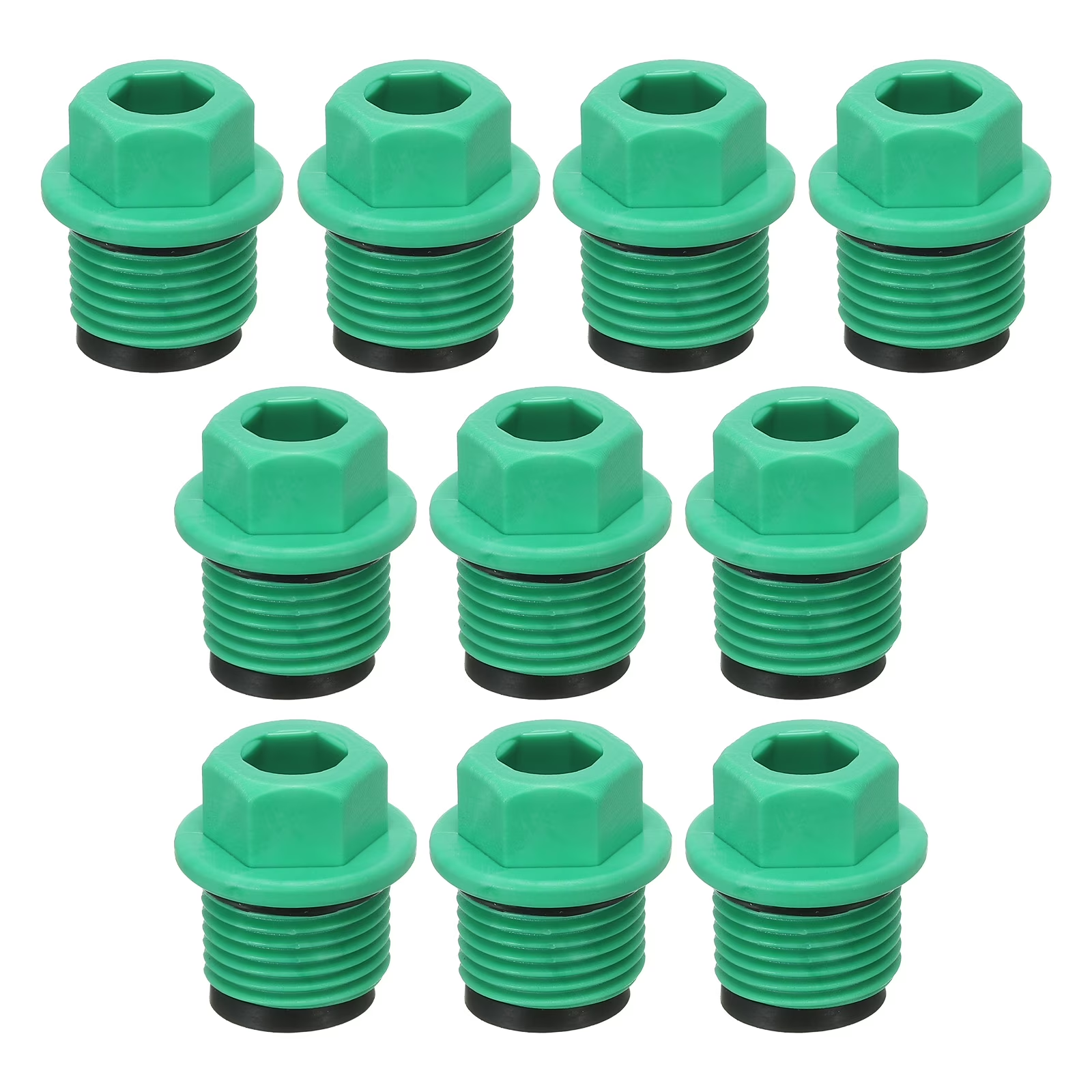
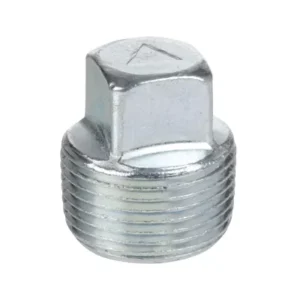
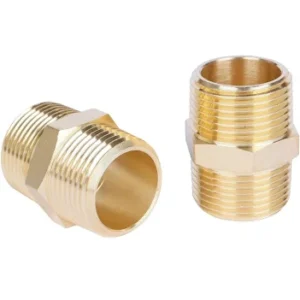
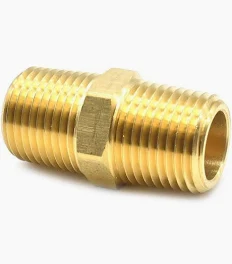
A PPR hex plug seals a female threaded outlet and tightens with a spanner.
The hex head gives a firm grip. As a result, it seals reliably for longer periods.
What is a PPR hex plug?
PPR caps and plugs close the ends of PPR pipes and threaded outlets. An end cap fuses onto a pipe end, while threaded plugs screw into brass outlets on tees, elbows and wall points.
Plugs keep tap points sealed until fixtures are fitted. Testing plugs seal outlets during pressure tests and then come out easily.
Further reading
- Polypropylene: properties and uses (Wikipedia)
- Plastic pipework materials compared (Wikipedia)
- Plastic welding and fusion joining (Wikipedia)
Key terms explained
- PPR
- Polypropylene random copolymer, a plastic made for hot and cold water pipes. It joins by heat fusion.
- Socket fusion
- Heating the pipe end and fitting socket on a welding machine, then pushing them together so they fuse into one piece.
- PN rating
- The pressure class, such as PN16, PN20 or PN25. A higher PN has a thicker wall for hot water and higher pressure.
- Outside diameter (OD)
- PPR is sized by outside diameter in mm, such as 20, 25, 32, 40, 50 and 63 mm.
- End cap
- A fitting that closes the end of a pipe.
- Test plug
- A temporary plug that seals an outlet during a pressure test.
Features and benefits
- Seals pipe ends and threaded outlets.
- Fusion or threaded types.
- Removable threaded plugs.
- Rust-free PPR or brass bodies.
Technical specifications
| Product | PPR hex plug |
|---|---|
| Material | PPR or brass, depending on type |
| Thread | Male, confirm size with quote |
| Head | Hexagon |
| Supplier | Sparks Plumbing Experts Ltd, Nairobi |
Sizes, PN class and colour depend on stock and maker. Tell us the size in mm and the quantity, and we will confirm.
Applications of a PPR hex plug
- Pressure testing. Seals outlets during tests.
- Unused tap points. Closes outlets until fixtures are fitted.
- Dead ends. Closes pipe ends permanently.
- Future extensions. Seals branches for later use.
- Tiling and finishing. Protects outlets from dirt during building work.
- Drain points. Closes drain outlets.
- Manifolds. Closes spare manifold ports.
- Repairs. Seals a line while a fixture is replaced.
How to choose and install
- Use a fusion cap on pipe ends and a threaded plug in brass outlets.
- Match the thread size of the outlet.
- Use testing plugs during pressure tests.
- Seal threaded plugs with PTFE tape or the plug O-ring.
Why choose Sparks Plumbing Experts
- Every common pipe materialGI, PPR, PVC, HDPE, brass and stainless fittings are all stocked, so you can match any existing system.
- Common sizes in stockMost fitting types come in several sizes, from small domestic sizes up to larger mains sizes.
- Pipes, fittings and valves togetherPipes, fittings, valves, clamps and jointing products come in one order.
- Help with thread and size standardsWe help you confirm inch and millimetre sizes before you buy, which avoids return trips.
- Visit or collect in NairobiOur store is at KCB Building, Enterprise Road, in the Industrial Area, so you can see parts before you buy or collect your order.
- Quotes your wayAsk for prices by phone, WhatsApp, email or the online quote form, whichever suits you on site.
- Over 1,600 products in one placeOur catalogue covers 55 categories, so one supplier can handle most of your parts list.
- Help choosing the right partSend a nameplate photo, a drawing or the old part, and we help you match size and specification.
- Single items or project quantitiesWe price a single replacement part just as readily as a full site order.
- Supply across East AfricaWe serve customers across Kenya, and we also supply buyers in Uganda and Tanzania.
Related products and accessories
Browse more: PPR Pipes & Fittings · Valves · Tapes · Plumbing Accessories & Tools.
Ordering from Sparks Plumbing Experts
We supply customers across Kenya, and we also serve buyers in Uganda and Tanzania. You can collect from our store at KCB Building, Enterprise Road, Nairobi, or ask us about delivery to your site. Send your quantities and specifications, and we will reply with prices and availability.
Request a Quote WhatsApp 0726 086 895
Frequently asked questions
Where is a PPR hex plug used?
In unused threaded outlets on tees, elbows and manifolds.
What details do you need to quote PPR plugs?
Tell us the size in mm, the PN class and the quantity. A photo of the old part, a nameplate or a drawing also helps. Then call or WhatsApp 0726 086 895, or use the quote form on this page.
Do you deliver PPR plugs outside Nairobi?
Yes. We supply customers across Kenya, and we also serve buyers in Uganda and Tanzania. Delivery or courier arrangements are agreed when you confirm the order.
How much does a PPR plug cost in Kenya?
The price depends on the size, the PN class and the quantity. Therefore, send your list with a quote request and we will reply with current figures.
Can PPR plugs be used for hot water?
Yes. PPR is made for hot and cold water. Use a suitable PN class for hot lines, such as PN20 or PN25.
How are PPR plugs joined?
PPR parts join by socket fusion with a PPR welding machine. Threaded and brass insert parts connect to metal with a sealed thread.
Which plug fits a PPR tap point?
A threaded plug that matches the brass outlet, usually 1/2 inch.
Can I remove a PPR end cap?
A fused cap must be cut off. Use a threaded plug where you will reopen the outlet.
What is a wing plug?
A plug with wings for hand tightening, often used during building work.
People also search for
end cap vs plug
A cap fits over a pipe end. A plug fits into a threaded outlet.
PPR pressure test procedure
Fill the system, plug all outlets, raise the test pressure and watch the gauge for the set time.
PPR plug price in Kenya
Prices change with size, model and quantity. Request a quote from Sparks Plumbing Experts for current figures.
PPR vs GI pipe
PPR does not rust and suits hot and cold water indoors. GI is stronger against knocks and sunlight.
PPR sizes mm to inches
In Kenya, 20 mm is commonly sold as 1/2 inch, 25 mm as 3/4 inch and 32 mm as 1 inch.
PPR welding temperature
Socket fusion tools usually work at about 260 degrees Celsius. Follow the machine and fitting maker instructions.
PN16 vs PN20 PPR
PN20 has a thicker wall and suits hot water. PN16 is often used for cold water.



Reviews
There are no reviews yet.