
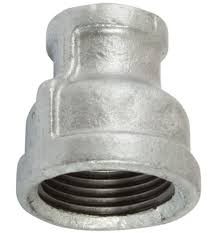
A GI reducer joins galvanized pipes of two different sizes in one fitting. It is used wherever a main steps down to a branch.
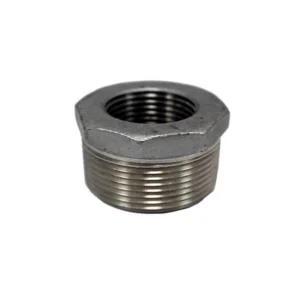
Reducers come as reducing sockets and reducing bushes. Therefore, tell us both sizes and which type you need.
What is a GI reducer?
A GI reducer is a galvanized threaded fitting that joins pipes of two different sizes. Water passes from the larger pipe to the smaller one, or the other way.
Reducers come as reducing sockets, which join two pipes, and reducing bushes, which screw into a fitting. Because they change size in one piece, they keep layouts short.
Further reading
- How hot-dip galvanization protects steel (Wikipedia)
- British Standard Pipe (BSP) thread explained (Wikipedia)
- Types of piping and plumbing fittings (Wikipedia)
Key terms explained
- Galvanized iron (GI)
- Iron or steel coated with a layer of zinc. The zinc corrodes first, so it protects the metal underneath from rust.
- BSP thread
- British Standard Pipe thread, the common pipe thread in Kenya. Tapered BSP threads (BSPT, ISO 7-1) tighten into a seal as you screw them together.
- Nominal size
- The trade size of a pipe or fitting, such as 1/2 inch. It names the pipe size, so it is not an exact measurement of the outside diameter.
- Thread sealant
- PTFE tape, hemp with jointing paste, or an anaerobic sealant applied to male threads. It fills tiny gaps so the joint does not leak.
- Reducing socket
- A coupling with a larger thread at one end and a smaller one at the other.
- Reducing bush
- A fitting with a male outer thread and smaller female inner thread.
Features and benefits
- Joins two pipe sizes in one fitting.
- Female BSP threads on reducing sockets.
- Galvanized finish that slows rust.
- Short, compact body.
- Screwed joints with no welding.
Technical specifications
| Product | GI reducer |
|---|---|
| Material | Galvanized (zinc-coated) iron |
| Types | Reducing socket or reducing bush |
| Thread | BSP taper |
| Sizes | State both sizes when you request a quote |
| Supplier | Sparks Plumbing Experts Ltd, Nairobi |
Size combinations vary with stock. Give both sizes, large end first.
Applications of a GI reducer
- Branch size changes. Steps down from a main to a smaller branch.
- Pump connections. Matches pump ports to larger suction or delivery pipe.
- Meter installations. Matches meter size to the pipe.
- Tank outlets. Steps a tank outlet down to the supply pipe.
- Valve fitting. Fits a smaller valve on a larger line.
- Irrigation lines. Reduces mains to lateral sizes.
- Gauge connections. Steps down to small gauge threads.
- Repairs. Joins old and new pipes of different sizes.
How to choose and install
- Specify both sizes, large end first, for example 1 inch x 3/4 inch.
- Choose a reducing socket to join pipes and a bush to reduce a fitting outlet.
- Seal male threads with PTFE tape or paste.
- Avoid large reductions on pump suction lines, because they can starve the pump.
Why choose Sparks Plumbing Experts
- Every common pipe materialGI, PPR, PVC, HDPE, brass and stainless fittings are all stocked, so you can match any existing system.
- Common sizes in stockMost fitting types come in several sizes, from small domestic sizes up to larger mains sizes.
- Pipes, fittings and valves togetherPipes, fittings, valves, clamps and jointing products come in one order.
- Help with thread and size standardsWe help you confirm inch and millimetre sizes before you buy, which avoids return trips.
- Visit or collect in NairobiOur store is at KCB Building, Enterprise Road, in the Industrial Area, so you can see parts before you buy or collect your order.
- Quotes your wayAsk for prices by phone, WhatsApp, email or the online quote form, whichever suits you on site.
- Over 1,600 products in one placeOur catalogue covers 55 categories, so one supplier can handle most of your parts list.
- Help choosing the right partSend a nameplate photo, a drawing or the old part, and we help you match size and specification.
- Single items or project quantitiesWe price a single replacement part just as readily as a full site order.
- Supply across East AfricaWe serve customers across Kenya. We also supply buyers in Uganda, Tanzania, Zanzibar, Rwanda, Burundi, DR Congo, Ethiopia and South Sudan.
Related products and accessories
Browse more: GI Pipes & Fittings · Valves · Tapes · Industrial Pumps.
Ordering from Sparks Plumbing Experts
We supply customers across Kenya. We also serve buyers in Uganda, Tanzania, Zanzibar, Rwanda, Burundi, DR Congo, Ethiopia and South Sudan. You can collect from our store at KCB Building, Enterprise Road, Nairobi, or ask us about delivery to your site. Send your quantities and specifications, and we will reply with prices and availability.
Request a Quote WhatsApp 0726 086 895
Frequently asked questions
What sizes of GI reducer can I order?
Common combinations step down one or two sizes. Tell us the pair you need.
Can I order GI reducers in bulk?
Yes. Include the size pairs and quantities in your quote request.
What details do you need to quote GI reducers?
Tell us the size, the quantity and what the item will connect to. A photo of the old part or a drawing also helps. Then call or WhatsApp 0726 086 895, or use the quote form on this page.
Do you deliver GI reducers outside Nairobi?
Yes. We supply customers across Kenya. We also serve buyers in Uganda, Tanzania, Zanzibar, Rwanda, Burundi, DR Congo, Ethiopia and South Sudan. Delivery or courier arrangements are agreed when you confirm the order.
How much does a GI reducer cost in Kenya?
The price depends on the size, the quantity and current steel prices. Therefore, send your list with a quote request and we will reply with current figures.
Should I use PTFE tape or paste on GI reducers?
Either works when applied correctly. Wrap PTFE tape clockwise on the male thread, or use hemp with jointing paste on larger sizes. Do not over-tighten, because that can crack the fitting.
Can GI reducers connect to copper pipe?
Avoid a direct joint between galvanized steel and copper, because the zinc then corrodes quickly. Instead, use a brass adaptor or, better, a dielectric union as the transition.
How do I order the right GI reducer?
Give both sizes, large end first, and say whether you need a socket or a bush.
Does a reducer lower water pressure?
A smaller pipe raises velocity and friction, so flow can drop. Size the smaller pipe for the flow you need.
Can I join two reducers in a row?
Yes, but a single reducer of the right size is neater and causes less loss.
Where can I buy GI reducer in Kenya?
Buy it from Sparks Plumbing Experts Ltd at KCB Building, Enterprise Road, Industrial Area, Nairobi. We are open Monday to Friday, 8 am to 5 pm, and Saturday, 9 am to 12 noon. You can also order by phone or WhatsApp on 0726 086 895. We deliver across Kenya and to Uganda, Tanzania, Zanzibar, Rwanda, Burundi, DR Congo, Ethiopia and South Sudan.
People also search for
reducing socket vs reducing bush
A reducing socket joins two pipes. A reducing bush screws into a fitting to reduce its outlet.
concentric vs eccentric reducer
A concentric reducer keeps the centre line. An eccentric reducer keeps one side flat, often on pump suction.
how to read reducer sizes
Sizes are written large end first, for example 2 x 1 1/2 inch.
GI vs PPR pipe and fittings
GI is stronger and handles knocks and sunlight. PPR does not rust and suits hot and cold water inside buildings.
GI fittings price in Kenya
Prices change with size, quantity and steel costs. Request a quote from Sparks Plumbing Experts for current figures.
how to fix a leaking GI thread
Shut the water, undo the joint, clean the threads, re-seal with PTFE tape or hemp and paste, then tighten firmly.
BSP vs NPT thread
BSP is the British thread used in Kenya. NPT is the American thread with a different angle, so the two do not seal together reliably.
galvanized vs black iron fittings
Black iron has no zinc coating and suits gas and closed heating loops. Galvanized suits water lines, because the zinc slows rust.


Reviews
There are no reviews yet.